Learning Profile
Part 1: Learning Moment Field Notes
For this activity, I decided to learn how to hit a jump while snowboarding.
Jot Notes:
- Actions: Snowboarded down to an area that I could hit a jump on multiple times
- Feelings: Scared to fall on icy conditions, frustration that I was not landing it, pain from falling the wrong way on my shoulder, tired from going multiple times, excitement because I am getting better, happiness because I landed it
- Inner thoughts: “this is going to hurt if I fall”, “my board sucks”, “I need a new board so bad”, “I need to get this before I leave today”, “okay I am getting closer”, “that was so close but I need to not bail last second”, “oh my god I finally did it”
- Sticking points: I have no toe edge on my board, my board is really old and is going to most likely snap in half at any point, the conditions kept getting worse as the day went on
- Successes: hitting the jump at a decent speed, landing the jump
Field Notes Write Up:
The activity I chose to do was learning how to hit a decent sized jump while snowboarding. I decided to make this my activity to learn as I have been snowboarding for a few years now and want to learn how to do park. I decided to do this activity on Monday 12/8/2025 as I did not have any classes that day and could spend a lot of time at the mountain. I went to Gunstock with my little brother who also snowboards and loves hitting park. My goal by the end of the day was to at least land a jump, but I was able to start going at a faster speed by the end of the day. Having my brother there was beneficial as he was able to point out what I was doing wrong and how I could improve the next time I tried.
The goal originally was to just be able to land a medium sized jump. When I first got there, I was nervous about the conditions because the first trail we went on to warm up was straight ice. Gunstock only has two trails open, one being a blue and the other being a black diamond. We decided to warmup on the blue as it was our first day back snowboarding since last season. The mountain was very windy and I knew that the hardness of the ice was only going to get worse as the day went on, which made me worried about falling when trying to land a jump. I also knew I was going to fall as I commonly bail from doing tricks as getting hurt is one of my biggest fears while snowboarding. After that run, we decided to check the other trail on the mountain that was open, which was a black diamond.
Luckily, the conditions on the black diamond were a lot better, as they were making snow as we went down. The only downfall to this was it made it difficult to see and there were huge moguls on the trail due to the snow falling in one area. Before attempting my first jump, I had some worry in me knowing my board is in rough shape. The board I have currently is very old and has no toe edge, which is crucial to have for snowboarding. Another downfall to my board is that because it is so old, it is starting to bend in ways it shouldn’t, meaning my board is going to snap in half in at any given moment if I land on it the wrong way. This made me nervous due to if my board breaks, I was guaranteed to fall and would then be stuck on the trail. Boards are also very expensive during the season, so it would make getting a new board difficult, resulting in me having to miss some of the season.
On my first attempt of hitting a jump, I landed on my toe edge and fell. Luckily when I fell, I fell on my knees and it did not cause much pain. My brother then explained to me that I needed to try to land with my board more flat. The next run, I attempted the same jump, where I bailed, causing me to land right on my bad shoulder. This was frustrating as I just recently popped it out and it was already in pain. I shook it off and took a little break after this to let the pain settle a bit. I then decided to go back up and try it again, where I was then able to land it. I was super excited when I landed it, though wanted to attempt hitting it at a faster speed to get more air.
We did a few more runs where I slightly increased my speed, not by much to not overdo it. I kept landing them, which caused me to get cocky on a run later on, where I hit it at a high speed, causing me to get a lot of air and bail. I ended up knocking the wind out of myself on the fall, though I was okay otherwise. After this, we decided to take a break and grab lunch to reset my mind. I was getting to impatient and wanted to be able to land it at higher speed, which caused me to go too fast. When we got back to the mountain, I did a few more runs, increasing my speed each time, until I was finally able to land it going about 30 miles per hour. This was super exciting as I was finally able to land it correctly without getting scared and bailing midway through. This skill is a skill I’ve been wanting to learn for a while, not only because I want to learn park, but also because sometimes on trails you may get some air on trails depending on the speed you are going.
Analytical Notes:
I think the best strategy for me was learning the landing form first and then slowly increasing the speed as I got better at hitting the jump. Trying to full send it definitely did not help and could have caused a very serious injury. I think also taking a break when I started to get frustrated was a good idea as it allowed to me reset my mind and calm down my nerves. The part that felt easiest to me was slowly increasing the speed and landing it. This method made the speed transition much easier as I was still focused on my mechanics, while adding a few miles per hour each time. When I went to try it at a faster speed than I was ready for, I was only thinking about my speed which I realized half way through, making me bail.
I felt a huge sense of clarity when my brother corrected me on my form when I landed too much on my toe edge. I was lazy with my legs, which caused me to in result be off balance when landing, which is why I was on my toe edge. Once he informed me of what I did, I was able to get it pretty quickly after. I would say the biggest point I got stuck was with my board and not having enough confidence in it. The entire time I was stressed out about my board breaking or making one wrong move and landing on my toe edge. I was also getting worried as the day went on because the conditions were getting worse, making it a lot more painful to fall. It also increased my risk of injury, which made me nervous as well as an injury would end the season for me.
The most difficult portion for me was trying to not get to ahead of myself with the speed. Last season, it was my goal to gain a lot of speed as I snowboard, which ended up filtering in when I was trying to hit the jump. I have a tendency of not taking my time to learn something, causing me to dive right into something without understanding everything. When I did the jump to fast, all my mechanics flew out the window. I feel as though my biggest distraction was the impatience and frustration I was feeling, as I wanted to be able to just do it. It caused me to overshoot what I was ready for.
For the most part, my self talk was actually pretty good. I tried to be as encouraging and positive to myself as I understood that I was going to fail. The run where I jumped the gun, I had told myself to man up and just send it. When I fell, I wanted to just give up completely as I did not think I was going to be able to get it by the end of the day. With the break I took after, it helped me get back to the more positive side of thinking, which I feel was very beneficial to me. I think I was both positive and critical, with both taking over at different points of the day. I always try to be a little critical as I am always seeking improvement, although being positive while being critical is important because it helps me feel encouraged to keep doing it. I notice a lot of the time where I get too critical, all I want to do it give up and I feel like it will never be something I will be able to achieve. I noticed I was getting to frustrated, which caused me to act on impulse. When this happened, I knew I needed a break to calm down, which was able to bring me back to my positive stage. I definitely had a lot of mood swings throughout the process, but in the end, I found a system to help me manage these emotions and remain calm throughout the entire process.
I was surprised to learn how impatient I was getting. Typically, I remain pretty calm while learning new stuff or am able to catch myself before I get too impatient. I think with this specific skill, this was something I have been wanting to learn for a while, just needed to work on other mechanics before I attempted to learn this skill. Usually, I tend to pick up on things pretty quickly, so not being able to pick it up as fast definitely caused emotions I am not used to having. The biggest pattern I learned was the mechanics of landing a jump. I realized the importance of mastering the correct form, as it would make the speed transition a lot easier for myself. I think next time I attempt to learn a new skill snowboarding, I need to incorporate more breaks when I can feel myself starting to get too overstimulated, frustrated, and impatient.
Part 2: Finding Your Learning Metaphor
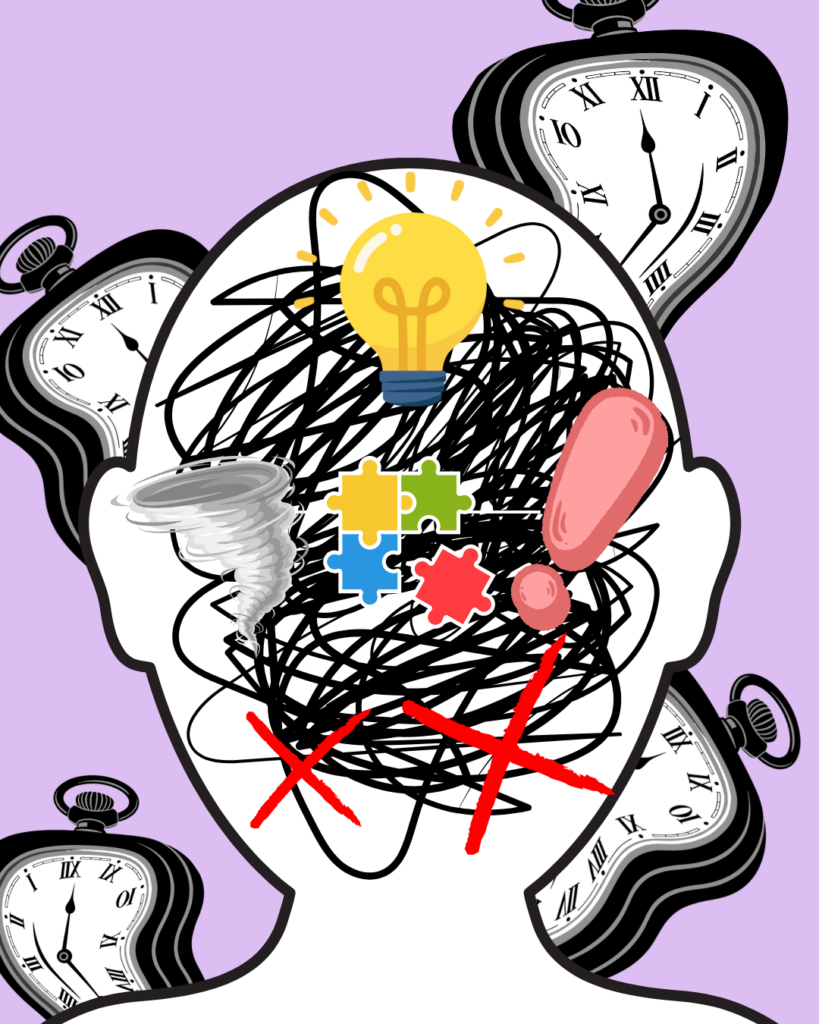
My drawing represents how I feel while learning a new skill. The clocks in the back are meant to represent how I feel as if time is slipping away as I continue to struggle to learn the new skill. Inside the brain of the person, it is chaotic as trying to take down notes from mistakes mixed with thoughts and emotions all begin to blend together. My brain is constantly filled with multiple things at once, making it very easy for me to mess up on the same mistakes as I become to focused on other things I am not currently working on.
Part 3: Takeaways From Class
Takeaway 1: Embodied Learning
Embodied learning is the process of using your body while learning, whether it is doing hands on work or simply moving around while learning. Moving while learning helps the information stick in your brain as it allows you to create cues in your learning with feelings or muscle memory. This topic related to me deeply as I am someone who thrives when moving while learning. My whole life, I have always needed to try something myself and learn from my actions. As someone who has always been curious, I was never able to take someone’s word for something, and I needed to test it myself. Moving while learning or doing a hands on activity helps me focus a lot as it keeps my mind and body busy at the same time. I have always struggled with lectures as I am unable to sit still for awhile, while keeping my attention on what is being taught. I often find myself playing mindless games or fidgeting with my fingers in order to remain focus and listen to what is being instructed. Learning more about embodied learning, I realized I am an embodied learner and have found ways for me to be able to move while I learn, which has helped me become a stronger student. A small component I will do to further test out this for myself is to try out different tactics to figure out what will be the embodied movement to help me learn. I want to try studying while going for a walk or maybe creating actions to resonate with key topics to help me retain the information better.
Takeaway 2: Having Difficult Conversations
Having difficult conversations can sometimes cause people to completely avoid them or not be able to get out what they need due to stress, pressure, anxiety, and other feelings. In class, we had a debate where we had to defend sides about the voting age, one side being pro for people 18 and older, while the other side thinking the voting age should be raised. Both sides was able to bring strong arguments, but what had stood out to me was how we maintained our composure during the exercise. We set rules beforehand, which is something I plan on using in the future when needing to have difficult conversations with people. It helps keep respect on both sides, while also being able to feel listened to and heard from. It definitely challenged my patience as some of the points I made got misinterpreted, causing me to stress out. I wanted to cut in and correct them, but I was able to let them finish what they had to say and then explain what I meant. I can definitely take this into use when having any conversation to help me not cut into when others are talking and let them finish what they have to say.
Takeaway 3: Equal Opportunities
Equal opportunity is something every system fails to achieve as there is almost no way to fully offer everyone the same opportunities. Everyone comes from different backgrounds, making it difficult to cater to every single person’s needs. In class, we had a discussion about how we can create better equal opportunity and one of the most common reasons as to what holds people back comes down to financial resources. This topic stood out to me as I have always been interested in starting a non-profit organization at some point during my career. Talking about what holds people back from getting a college education or how it may affect different people from playing professional sports really opened my eyes in understanding what some of the core reasons opportunities aren’t equal. This challenged my way of thinking because I assumed a lot of the reason was because some people weren’t putting in the effort, which in the case is not always true. With being able to now put myself in other people’s shoes, I would eventually like to talk with more people with different backgrounds and see what the differences are that they had experienced in their life to get them to where they are today.
Takeaway 4: What Industrial Societies Get Wrong About Childhood
In this reading, the author had talked about how children are experiencing great difficulty with decision making and having the fear of being wrong. This has been something I have noticed a lot with the younger generation as I coach a lot of younger children. Growing up, I was always able to make decisions and had no fear of being wrong. I actually liked to be wrong because it gave me the chance to learn from something and try again until I’ve mastered it. This reading explained to me why the kids I coach are so different than how I was at their age and helped me understand what I need to do to help give these kids the support they need to be able to make decisions and have no fear of being wrong. It gave me a new perspective on how kids learn these days and I have noticed that the kids who get really high grades in school are the kids who tend to have the hardest time making a decision. I have started implementing decision making in my coaching, to allow the girls to learn to make choices, while also helping them deal with the consequences of being wrong. I would like to keep on working on this with my girls and I think the best way for me to do that is to set up a scrimmage where I do minimal coaching and praise them anytime they make a choice, even when they are wrong. I think the best option for me right now is to work on building that confidence in decision making, then tackling how to deal help them deal with being wrong.